Mostrando entradas con la etiqueta 2nd CYCLE. Mostrar todas las entradas

MY DAILY ROUTINE CHART


What are we going to do at the beginning of each English lesson? Yes, I would like to describe you my Daily Routine Chart.

Take a look…It is compounded by day, month, year, weather, days of the week, pockets to introduce the rest of the material, and two more important things: a part dedicated to my eTwinning Project, in which we stick a representation of the vocabulary of the topic, ecause students establish comparisons thanks to the project; and another part dedicated to my Magic Books Project, in which we stick the chapter (or chapters) of the book ‘Harry Potter and the Philosopher’s Stone’ that students are reading during any egrated Didactic Unit.

From my point of view, this visual material is essential to start the class in a pleasant atmosphere, getting vocabulary, the adequate affective filter and providing organisation and a daily routine to my English lesson.


PROJECT: MAGIC BOOKS


In order to develop it, pupils are divided into heterogeneous and flexible groups of four that can be changed to satisfy all the pupils’ mixed-abilities. It is formed six groups, each of them corresponds to a different house of ‘Hogwarts’, but they are not called like in the book since there are only four houses. Instead of it, each group (or ‘house’) is assigned with a different name and colour. They are what you see in this map: Oxford (blue), Cambridge (purple), London (red), Belfast (yellow), Cardiff (green) and Edinburgh (white).


This map of the UK is hung in the English Corner as a representation of the six houses (or groups), each one with its corresponding colour. They are linked to cities from the U.K., so pupils can learn geography of English speaking countries besides embedding them in the project, creating some expectations and improving motivation towards the Project.


And how do I carry out? Students read the adapted book ‘Harry Potter and the Philosopher Stone’. Some chapters in each IDU are read by my students at home. How? Don’t worry, I provide every student the adapted book, created by me according to the cognitive stage and level of English of my class group, with images to better understand what they are reading. Moreover, every chapter is uploaded to my blog.


Next, now in the class, an informal chat about the general ideas of the chapters is done at the beginning of the session. Then, students, in small groups, read and answer some questions about the adapted chapters through the digital programme Plickers, in which every ‘house’ has to raise this card with a code which corresponds with the chosen answer during the Quiz. I scan groups’ answers through a smartphone, and then the outcomes appear on the Interactive Whiteboard. If they do it right, they earn points that are symbolized as ‘Quidditch balls’, so in this case, the house ‘London’ sticks one Quidditch ball on its board. 


Part of the wall corresponding to the English corner is decorated with the badges and colours of the house that earns more ‘Quidditch balls’ until the next unit. Of course, in my role as an English teacher I have to try that all pupils participate during the session and exchange ideas using English as the main via of communication.


But, why do I do this?  Basically, this project is an excuse. An excuse to get that students improve their level of competency in English (reading and predictive skills, fluency, vocabulary, grammar structures…) in an enjoyable and interactive way through the reading of an adapted book, using these materials to catch students’ attention and motivation, and prompting participation towards the project.

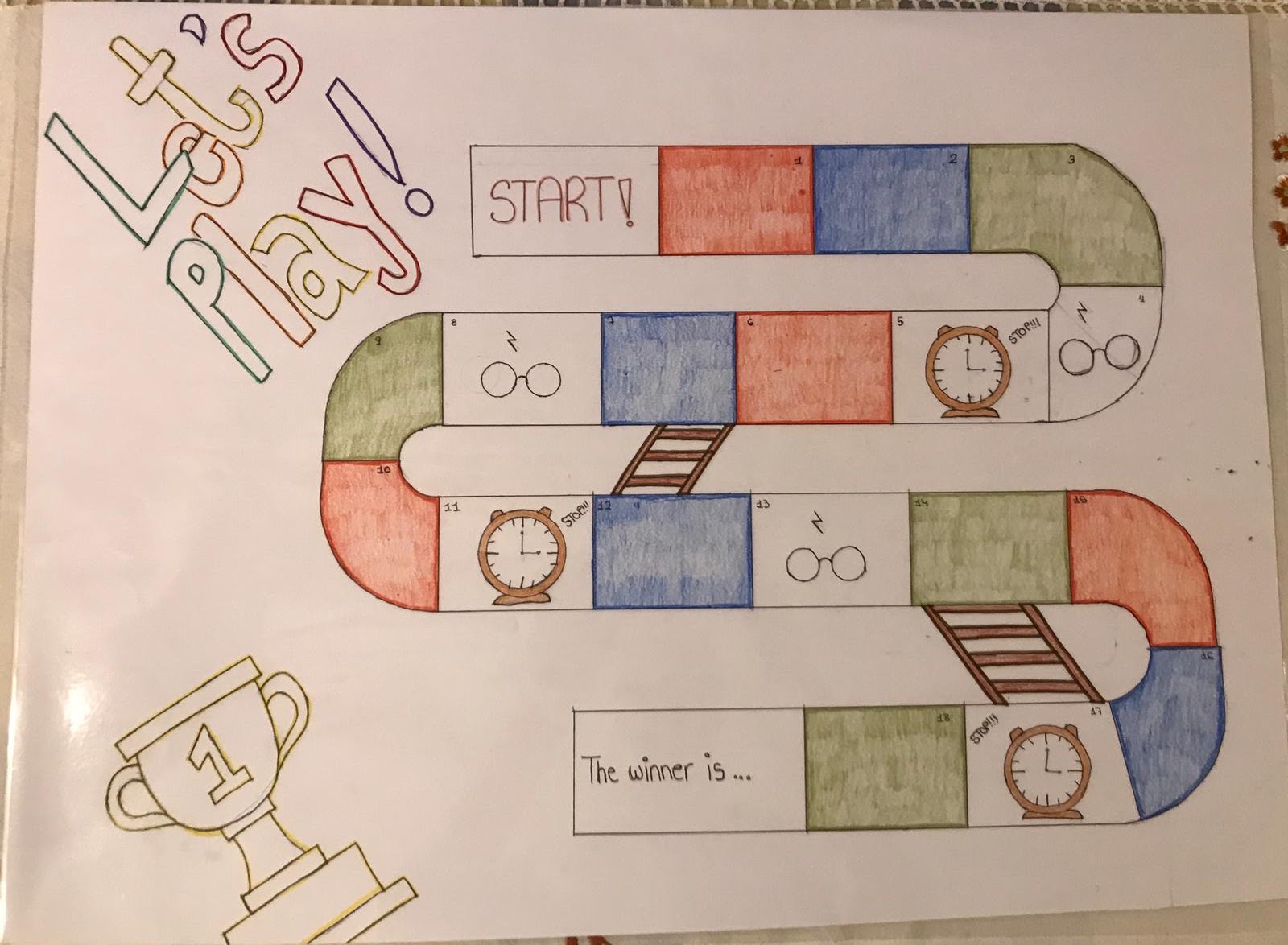
My board game: TABOO


I have to recognise that I love board games. For this reason I have created a board game in which students practise the vocabulary of a topic in a funny and enjoyable way. A board game with ladders, stops and different colours: if the colour is blue; the word must be represented through a drawing; if it is red, through miming, and if it is green, through a brief and simple description. Moreover, there are some boxes in which students must answer a question about the reading of the Harry Potter book (the Magic Books Project). This game tries to improve cohesion and inclusion in the class, because cooperative work and non-verbal communication are essential in the development of the game, so attention to diversity is highlighted.


THE CRAZY ENGLISH ALPHABET

Pronunciation is probably one of the most hated things for children in English classrooms. Here we are a webpage in which learners can practice how a letter is pronounced in a different way, depending on their position in the word, prompting expectations and arousing previous knowledge.

http://repositorio.educa.jccm.es/portal/odes/ingles/cuaderno_5pingl_the_alphabet/index.html

VOCABULARY: THE SCHOOL, THE PARK, THE HOUSE

This is a funny resource in which students can practise the vocabulary related to their closest context in an interactive and enjoyable way. Enjoy it!


READING THROUGH FOLK TALES...

As we all know, traditional literature (Folk Tales) represents a precious authentic material for the English classroom. So, in the next web site, we can practise reading skills through some Folk Tales adapted to English learners. Have a look!

https://www.starfall.com/h/ir-folk/?sn=im-reading